
Sovereign AI for
the Five Billion
Why the application layer is where the value of artificial intelligence settles, and why the fund argues from the DIFC.

Frontier artificial intelligence is built in a handful of places and funded by a smaller handful of balance sheets. Most of the people it will change live somewhere else.
Five billion is a frame, not a census: the customers of banks, insurers, telcos and employers from Cairo to Karachi, Dhaka to Jakarta, Nairobi to Lagos, who will meet artificial intelligence not as a subscription but as better outcomes inside institutions they already deal with. A loan approved in a day instead of a season. A diagnosis within reach of a nurse who has never had a consultant down the corridor. A shipment financed because software, at last, can afford to read the paperwork. For most of the five billion, the first professional attention they can afford will arrive as software. Intelligence is becoming infrastructure, and infrastructure has always been a question of who owns it.
Universal Venture Capital is the venture brand of Universal Asset Management Limited, a DFSA-regulated manager in the Dubai International Financial Centre. What follows is the argument the fund is built on.

The shape of the opportunity has changed
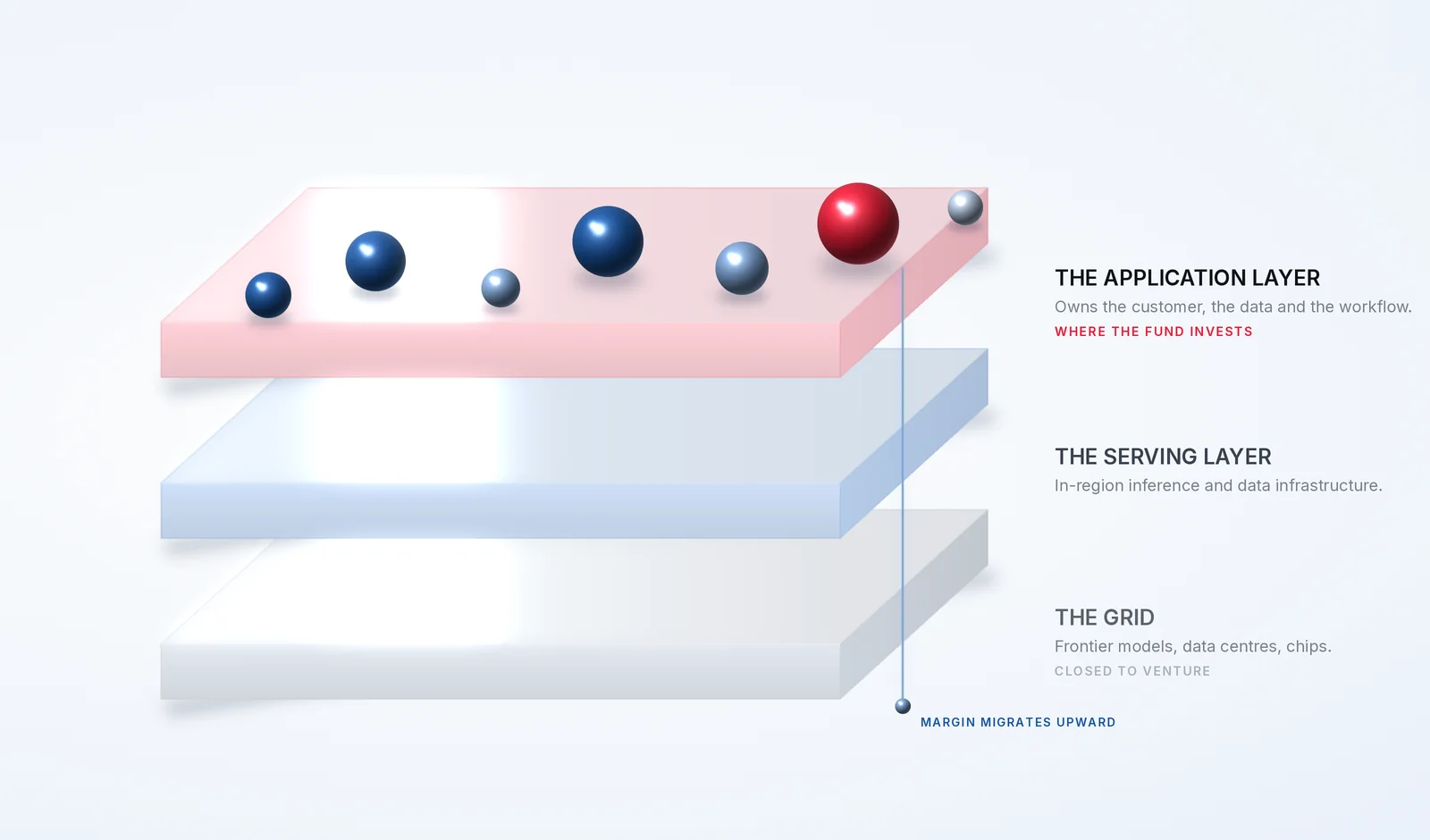
The first decade of the build-out belonged to the model laboratories, and the capital that carried them was never venture capital. In 2015 the frontier could still be funded like a startup. By the mid-2020s a single training run was priced beyond the reach of most venture funds, and the next generation is priced beyond venture as an asset class. The investors who underwrite the laboratories now are the hyperscalers whose clouds and chips the models consume, Microsoft with OpenAI, Amazon and Google with Anthropic, Nvidia with OpenAI, and they are buying customers for their infrastructure as much as equity in models. The ticket to that table is a data centre the size of a city. Those are strategic positions, priced as such, and closed to venture capital by design. The laboratories are building the grid, and the grid will be magnificent.
This fund is built for what the grid switches on. When capital at that scale industrialises intelligence, the output becomes a utility: metered, priced per token, cheaper every quarter, available to any builder with an API key or a downloaded set of weights. History has a name for this moment. It is the point at which electricity left the laboratory and became a socket in the wall, when the question stopped being who could generate power and became who would build the machines, the factories and the businesses that ran on it. The investor's question moves the same way: not who trains the best model, but who turns its output into companies. The frontier is priced. The application layer is not.

Intelligence is now an input
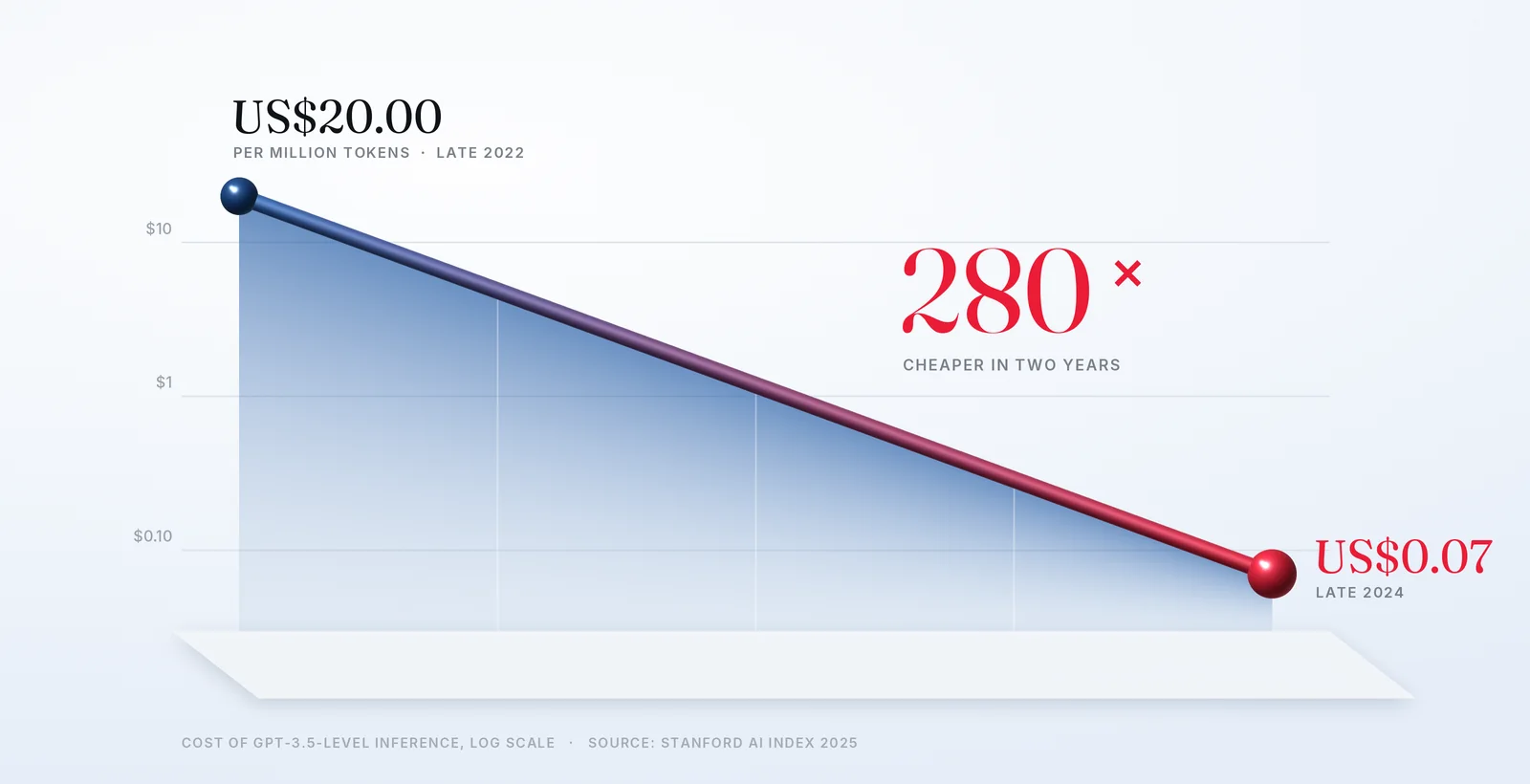
What electricity did to muscle, machine intelligence is doing to expertise, and it is repricing faster than either of its great predecessors. Electricity took half a century to become cheap. Computing took a generation. Intelligence is repricing in quarters: Stanford's AI Index measured the cost of GPT-3.5-level inference falling from twenty dollars per million tokens in late 2022 to seven cents by late 2024, a fall of more than 280-fold in two years.
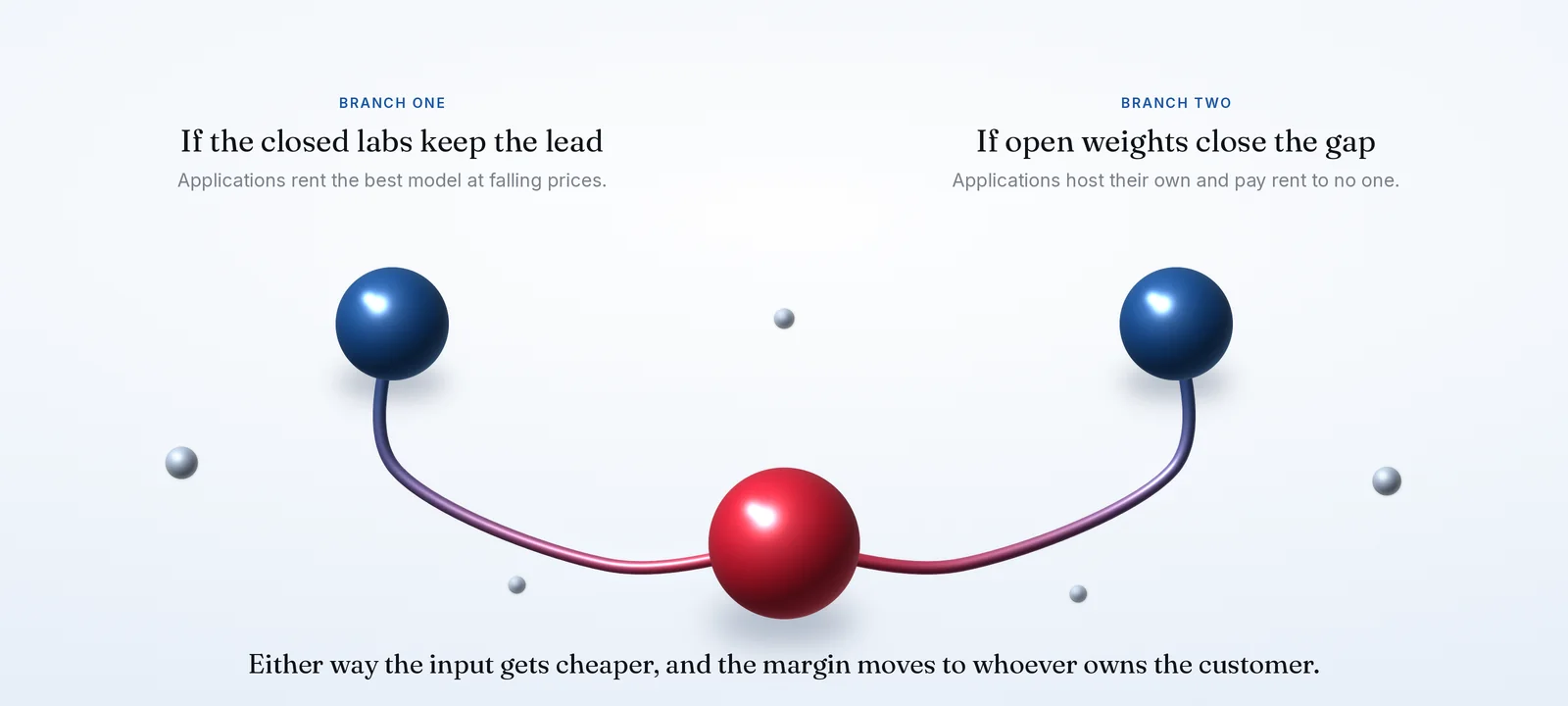
Two branches of the model race matter to an investor, and the application layer wins in both. If the closed laboratories keep their lead, application companies rent the best model in the world at prices that fall relentlessly. If open-weight models close the gap, and DeepSeek, Qwen, Kimi and Llama already carry most routine work, those same companies host their own intelligence and pay rent to no one. There is no branch of the race in which the application layer loses pricing power. That is the quiet beauty of its position: it is long intelligence itself, indifferent to which laboratory wins.
The nature of the input has changed as much as its price. Models no longer answer questions; they execute work: a loan file assembled, a claim adjudicated, a shipment financed, a customer served in her own language at two in the morning. What an application sells is completed labour. And the falling price is the starting gun, because intelligence priced in dollars per million tokens served an enterprise seat costing thousands a year, while intelligence priced in cents serves a customer in Karachi or Lagos paying a few dollars a month. Somewhere in the last two years, quietly, the unit cost of professional attention crossed below what the five billion can pay. Half of humanity has just become a market.
The model is the commodity.
The application is the asset.
Where the value goes
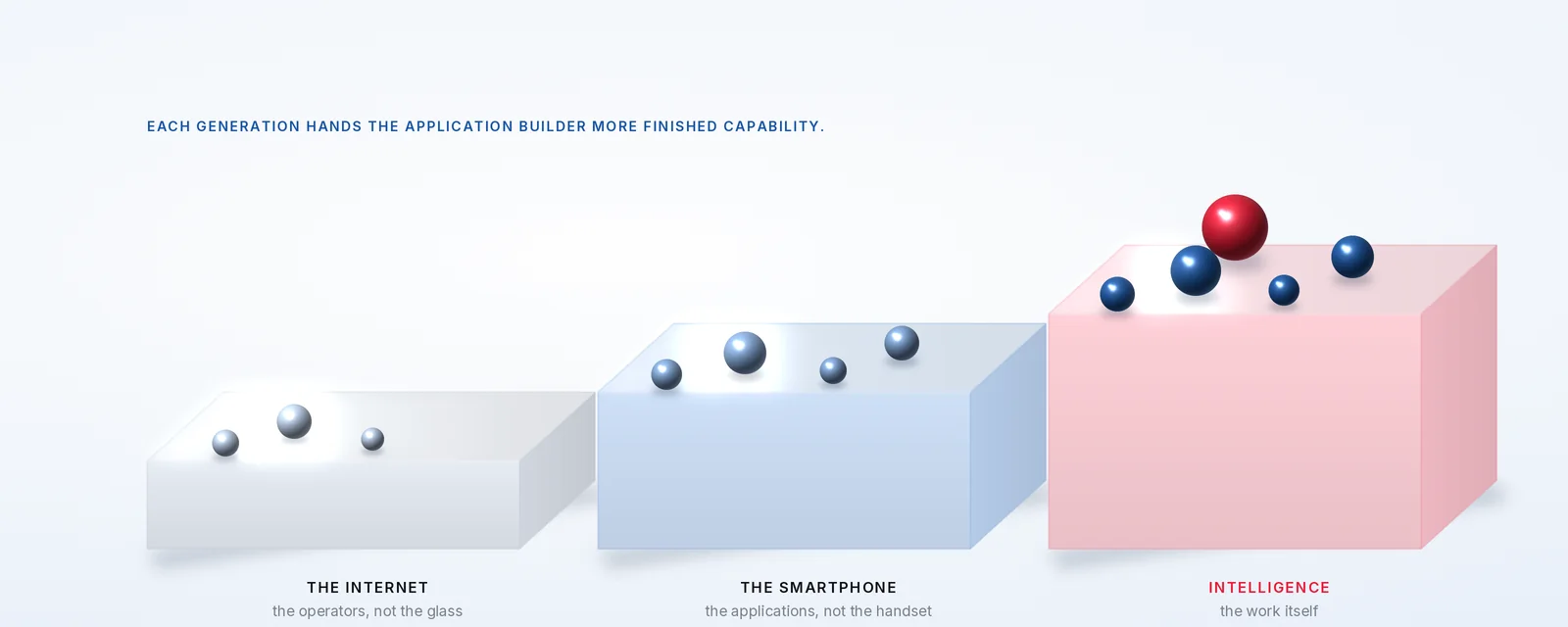
Every platform shift asks investors the same question and punishes the obvious answer. When the internet arrived, the obvious trade was infrastructure, and the capital that laid the glass mostly burned; the companies that ran on it became the most valuable in history. Amazon went public in 1997 valued at less than half a billion dollars, and the market saw a bookshop. The first cheque into Google was written to a company that did not yet legally exist; the investor had seen the demonstration and declined to wait for the paperwork. Google itself bought YouTube in 2006, and from that day no outside investor got a venture seat in the platform. The open seats were on the other side, with the operators who built businesses on its distribution, and those seats made the era's quiet fortunes.
The pattern repeated on the smartphone. Instagram reached a billion-dollar sale in 2012 with thirteen employees. WhatsApp reached nineteen billion with roughly fifty engineers. Neither built a phone, an operating system or a network; they built applications on infrastructure someone else had paid for, and the value settled with them. Each platform generation has needed fewer people to build more value, because each generation hands the application builder more finished capability. Artificial intelligence hands them the most finished capability yet: the work itself.
Today's grid differs from the fibre era in one respect: it is financed by owners with captive demand, so it will be built regardless of what any single application earns. The lesson is not that infrastructure fails; it is where durable equity value settles, and it settles above the grid. Nobody buys a frontier laboratory at a seed price in 2026. The garage-stage cheques of this era are being written into the application layer, and mostly in places the obvious capital does not visit. There is a short season in every shift when that layer is still priced like an argument; for the internet it ran from roughly 1995 to 2005, and for artificial intelligence it is running now. By the time a thesis is respectable, it is expensive. The argument is the discount. Back the operators, not the platform.
What qualifies: the five tests
A hot market is not a filter. The fund applies five tests to every application company it sees, and together they answer a single question: when the price of intelligence falls again next quarter, does this company capture the difference, or merely pass it along?

The first test is ownership of the customer and the data. The company must hold the relationship in its own name and accumulate the workflow data its operations generate, because that data is the one input no laboratory can train on and no competitor can download. A company that reaches its users through someone else's platform, on someone else's terms, has a distribution deal, not a moat.
The second is a regulated position. A licence, a supervised process, a statutory obligation: these read as burdens and price as gold. Horizontal platforms scale by avoiding exactly this work, one jurisdiction's rules at a time, which is why the companies that do it inherit the field. Where a regulator stands between a workflow and a general-purpose model, the specialist keeps the margin.
The third is distribution through institutions the market already deals with. Banks, insurers, telcos, employers: the five billion meet new technology through them or not at all. Selling an app subscription to a smallholder is a fantasy; embedding intelligence inside the bank that already holds their account is a business.
The fourth is selling the work, not the tool. Software seats are a budget line; completed labour is a cost replaced. The company that assembles the loan file, adjudicates the claim or finances the shipment charges against the salary it displaces and keeps more of the difference each time the input gets cheaper. Sold as work, a falling model price is expanding margin. Sold as a seat, it is a discount handed to procurement.
The fifth is model agnosticism by architecture. Every model, closed or open, must be replaceable in weeks without the customer noticing. This is what makes the company long intelligence rather than long any vendor, and it is the test the first generation of thin wrappers failed in public: they were features wearing valuations, and the platforms' next release cycle collected them.
Most companies will fail these tests, and some that pass will still lose; that is venture, and the tests exist because the winners are few and concentrated. Wrappers rent their advantage by the token. Owners compound it. Companies that pass all five get stronger with every model release, whoever ships it.
Sovereignty, at the right layer
National compute programmes are rising across the Gulf and beyond, and they matter: they are part of the grid this thesis runs on. Sovereignty itself is settled at a different layer. A bank's customers do not become sovereign because a model was trained nearby; they become sovereign when their data, their relationships and the decisions that affect them are held under the law of the market they live in, on intelligence the operator can replace.
The law is arriving faster than the infrastructure. India's Digital Personal Data Protection Act 2023, Indonesia's Personal Data Protection Law of 2022, Nigeria's Data Protection Act 2023, Saudi Arabia's Personal Data Protection Law, the UAE's federal data protection statute: jurisdiction by jurisdiction, the markets of the five billion are writing residency and accountability into statute. Every one of those laws is a moat for the operator who complies in-region and a wall for the horizontal platform that cannot. Compliance is not the tax on this thesis. It is the subsidy.
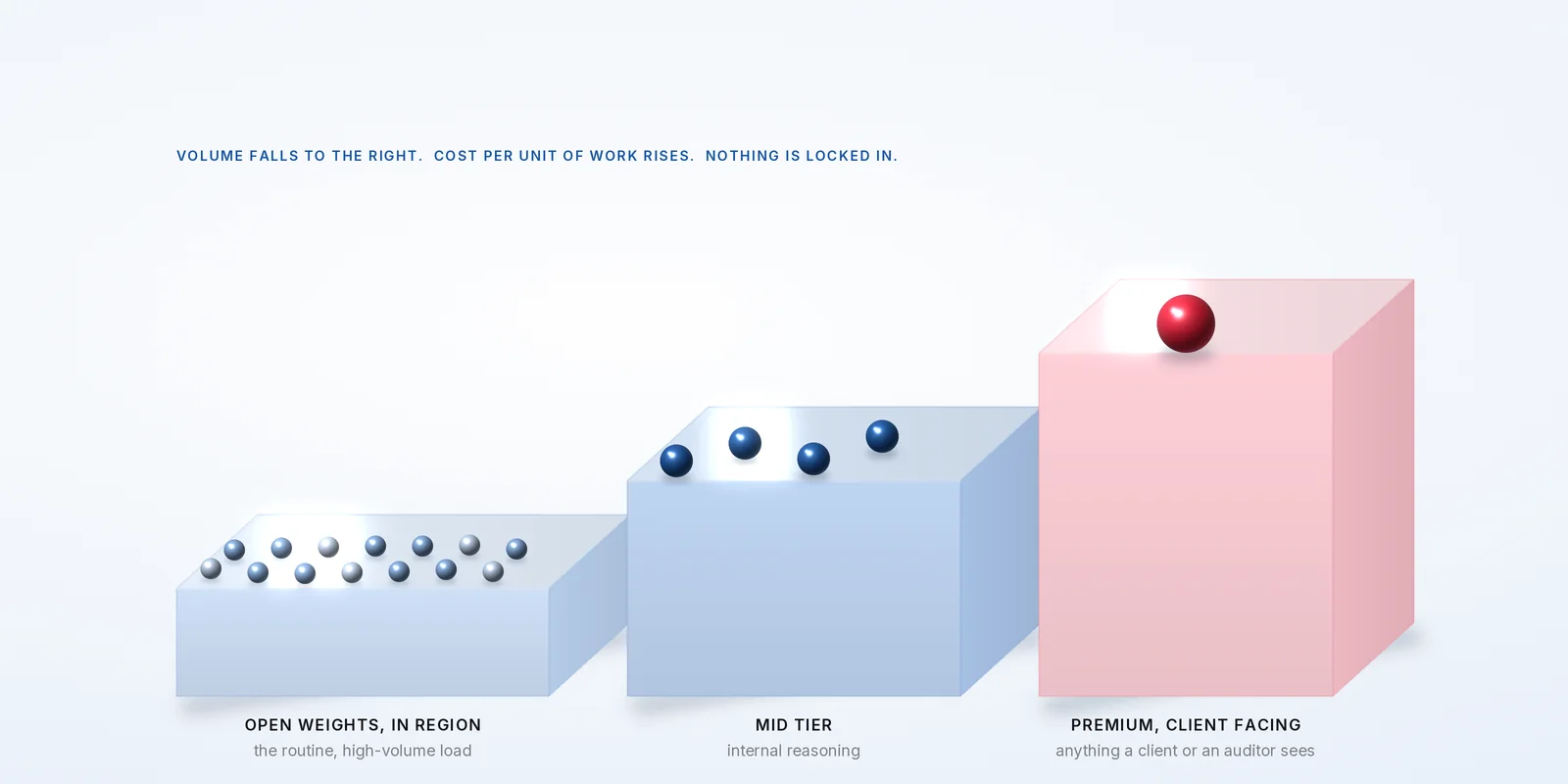
The sovereign architecture already exists and already runs in production: open-weight models hosted in-region for routine work, a frontier model reached under residency terms for the hardest reasoning, every component replaceable in weeks. Accountability lives in a licence, a ledger and a law, not in a flag on a building. That is what sovereign AI means in this thesis: ownership of the layer where accountability lives. Where the fund backs infrastructure, it backs this serving layer, in-region inference and data infrastructure built to carry applications.

The DIFC position
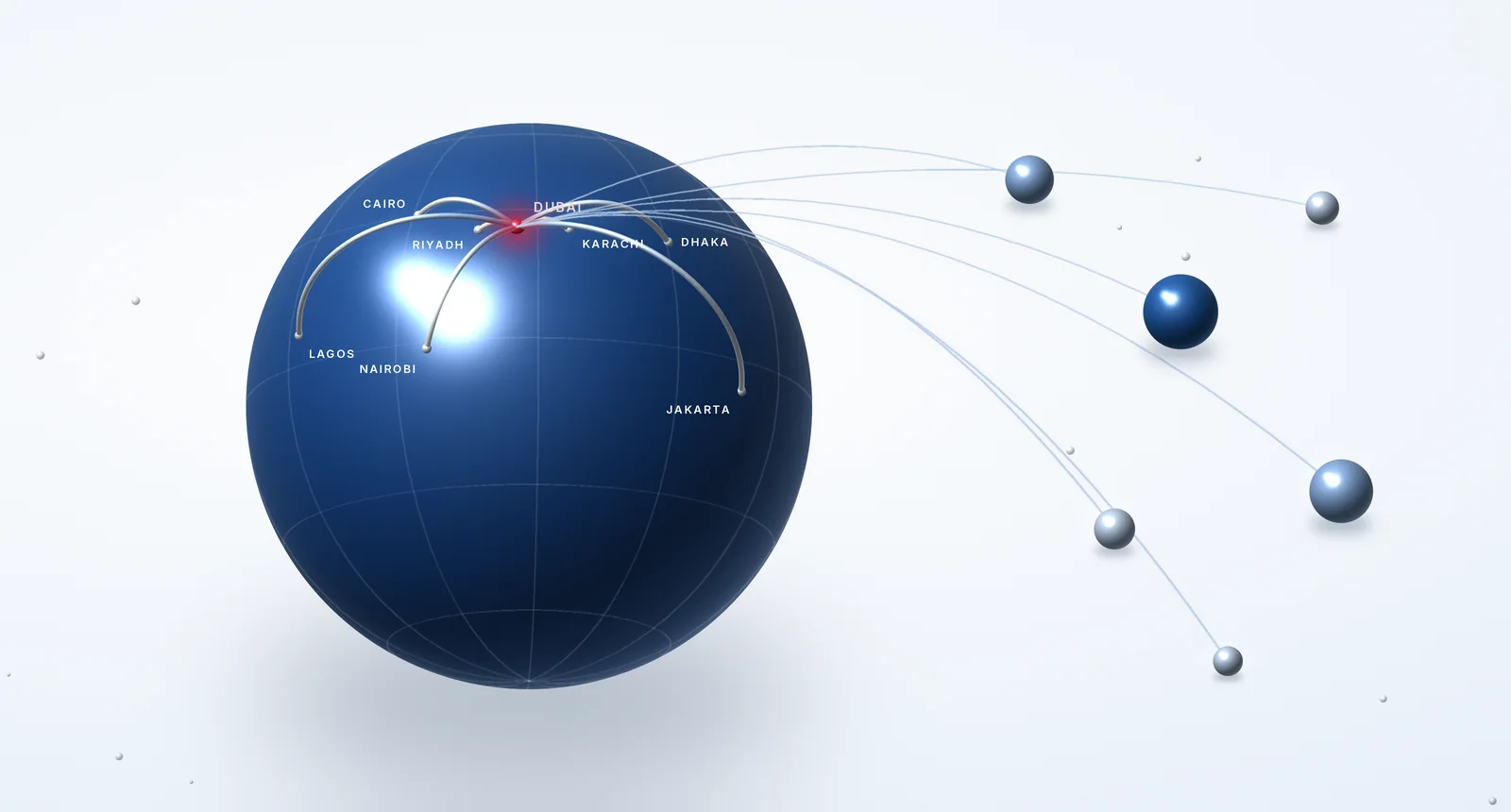
Universal Asset Management Limited has been authorised in the Dubai International Financial Centre since 20 December 2023. The mandate is global; the seat is deliberate. The DIFC sits at the midpoint of the world this thesis serves, an arc from Dubai through Cairo, Riyadh, Nairobi, Karachi, Dhaka, Jakarta and Lagos that holds close to a billion people in five of its countries alone, most of them young, connected and under-served in precisely the services this fund exists to change. Common-law courts, a regulator built for funds, and a time zone that touches the whole arc inside a working day. Capital that wants exposure to that world needs a seat governed by law it recognises, close enough to the markets to price them properly. Placement is the strategy.
Jurisdiction is the other half of the structure. The DIFC operates a common-law framework of its own, enacted in English, with the DIFC Courts as the forum and English as the language of proceedings. An investor accustomed to English commercial documents finds the instruments, the forum and the remedies familiar. That familiarity is not decoration. It is what lets capital raised under one legal tradition be committed with confidence to companies operating under another, which is the problem this fund exists to solve.
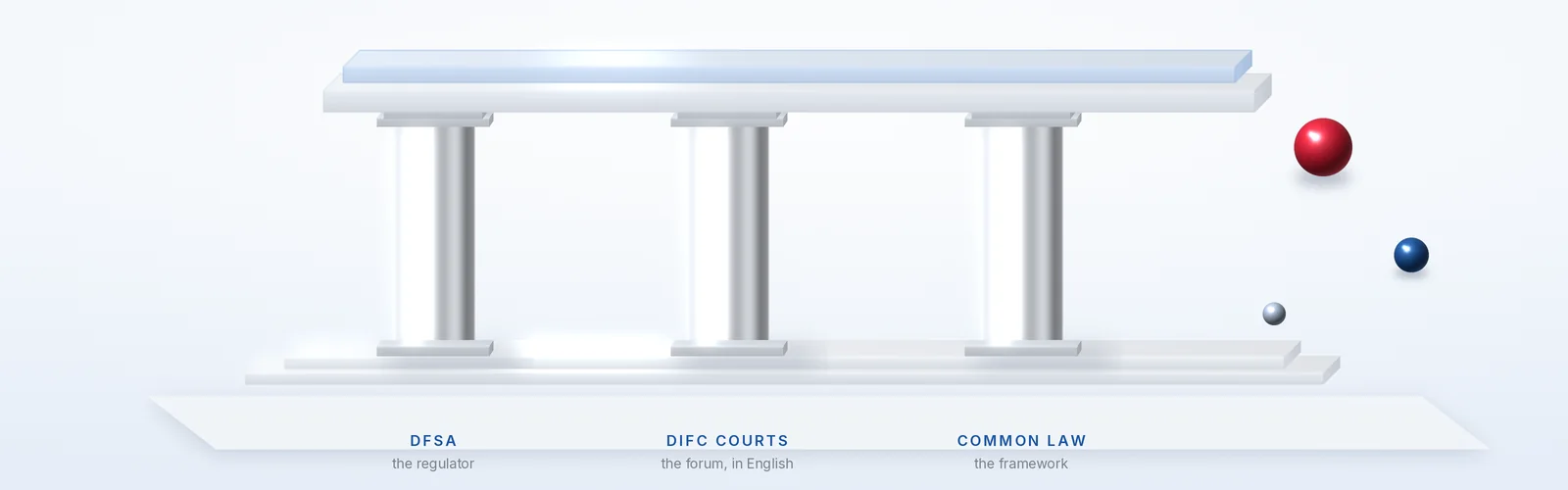
The vehicle is built to be recognised rather than explained. UVC AI Frontier Fund I is a closed-ended limited partnership registered in the Dubai International Financial Centre and classified under the DFSA Collective Investment Rules as an Exempt Fund of the Venture Capital Fund type. Its general partner, AI Frontier Fund 1 GP Limited, is a DIFC private company incorporated on 31 July 2026 under registered number 14022; it carries no financial service of its own and delegates management to Universal Asset Management Limited. The licence sits with the manager: DFSA reference F008012, granted 20 December 2023, for Managing a Collective Investment Fund, restricted on the public register to fund management in respect of Qualified Investor Funds and Exempt Funds which take the form of Venture Capital Funds. Units are offered to Professional Clients only, by way of Private Placement.
Authorises and supervises the fund manager. Reference F008012, licensed 20 December 2023. Licensed Financial Service: Managing a Collective Investment Fund.
AI Frontier Fund 1 GP Limited
DIFC private company, registered number 14022
Incorporated 31 July 2026
No financial service of its own
Universal Asset Management Limited
DFSA reference F008012
Managing a Collective Investment Fund
Management delegated to it by the general partner
DIFC limited partnership, closed-ended. Exempt Fund of the Venture Capital Fund type under the DFSA Collective Investment Rules. Units offered to Professional Clients only, by way of Private Placement.
Where the fund invests
The mandate is defined by the tests, not by a map. The fund is location agnostic and invests wherever the thesis holds: an application company in Dhaka, Dubai, London or San Francisco is judged by the same five tests, and the licence carries no geographic restriction. The five billion are where the tests pass most often and at the steepest discount, so that is where capital will naturally concentrate; a consequence of the thesis, not a constraint on it.
The first verticals sit where the gap between what institutions need and what software has delivered is widest. Trade finance runs on paper, judgement and correspondent relationships. Health runs on scarce expertise. In both, the shortfall is measured in figures large enough to be structural rather than cyclical.
The global trade finance gap in 2022, most of it borne by smaller firms in exactly the markets this thesis serves. A system that reads a bill of lading, screens a counterparty and assembles a compliant file moves the frontier of who gets financed at all.
Asian Development BankThe projected shortfall of health workers by 2030, overwhelmingly in low- and middle-income countries. No training pipeline on earth closes it in time. Intelligence that triages, documents and supports the clinicians who do exist turns a queue into a diagnosis.
World Health OrganizationThe third vertical is the serving layer itself: in-region inference and data infrastructure built to carry applications under the residency statutes above. In every vertical the buyer is an institution, the workflow is licensed or regulated, and the unit economics turn on completed work. Frontier, in this fund's name, means the deployment frontier: the markets and workflows where intelligence is being put to work at scale for the first time, on models the frontier laboratories keep improving. The fund does not train models. It compounds what they make possible.
We do not fund the power station.
We fund what it electrifies.
An operating sponsor
The manager's sponsor group builds and runs an AI-native, regulated financial services platform in the United Kingdom. Inside that platform the thesis is operating procedure, not theory. The five tests describe how the group's own businesses are built, so the fund's diligence is an operator reading another operator's engine room, not an analyst reading a deck.
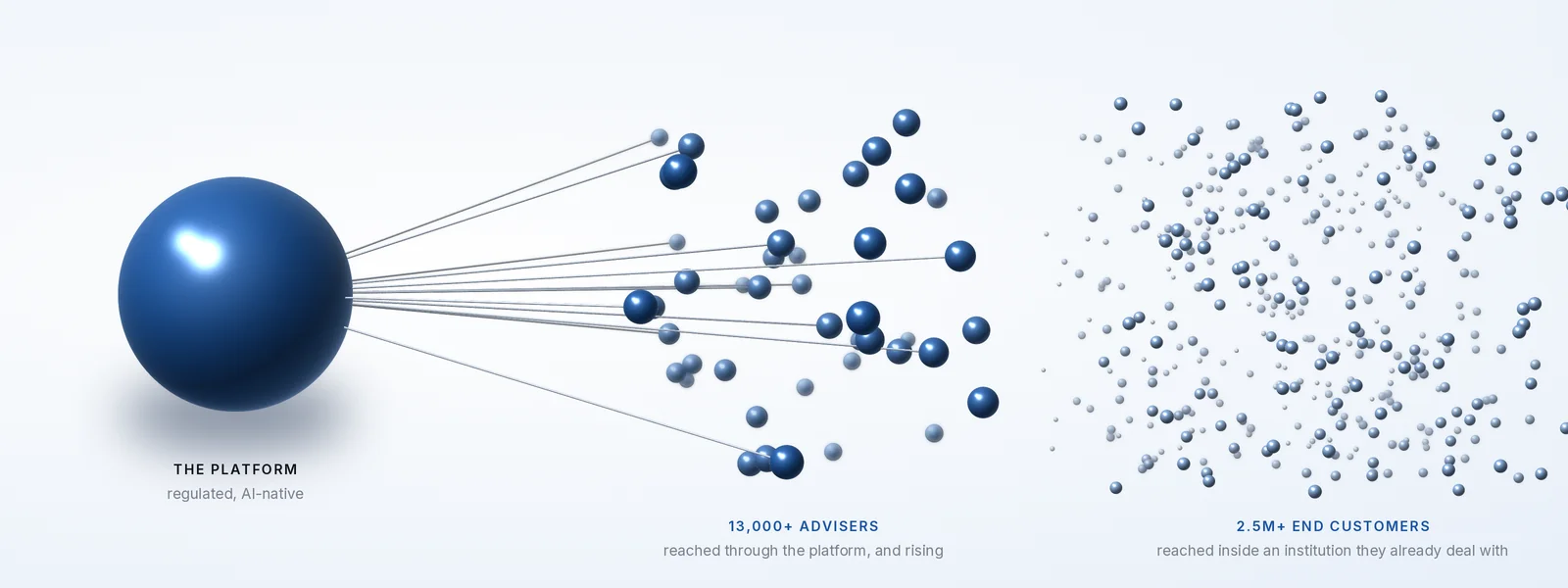
Advisers reached through the sponsor group's regulated platform, and rising. Distribution through institutions the market already deals with, met in the group's own operations before it was asked of anyone else.
End customers reached through those advisers. The test is not how many people hear of a product; it is how many are reached inside an institution they already deal with.
The routing is the part worth copying. Work is graded before it is sent anywhere: the routine, high-volume load runs on open weights hosted in region, internal reasoning sits a tier above, and only what reaches a client or enters a regulated audit trail is sent to a premium model. Nothing is locked in. When a cheaper model clears the bar for a tier, it takes that tier, and the saving stays with the operator rather than the vendor.
The manager exports a thesis it already runs into markets where the constraint is real and the prize is larger. Operating proof travels better than a pitch.

Every generation of investors gets one platform shift.
Most meet it by buying the previous one's winners at full price.
The shift is here. Intelligence has become infrastructure, its price is collapsing, and the application layer above it is still priced like an argument.
The five billion are where that layer will compound hardest, because that is where the gap between what expertise costs and what people can pay has always been widest, and it has just closed.
This fund exists to hold early positions in the companies closing it. Intelligence is becoming infrastructure. Infrastructure has always been a question of who owns it. We intend the answer to include the markets it serves.
Universal Venture Capital. Sovereign AI for the Five BillionFor founders
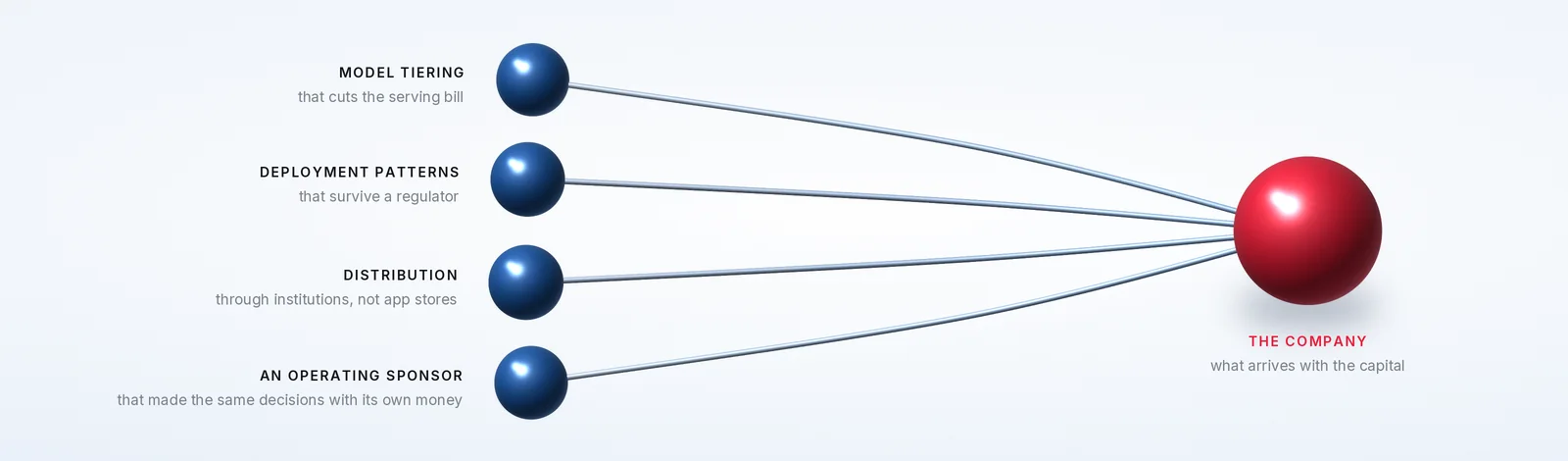
If the company passes the five tests, or would with the right partner behind it, the fund wants the conversation early: pre-seed and seed, anywhere, building on models it does not train. What arrives with the capital is the playbook: model tiering that cuts the serving bill, deployment patterns that survive a regulator's inspection, distribution through institutions rather than app stores, and a sponsor group that has made the same decisions with its own money. The next companies of consequence will be built where the constraint is real.
What we look for, in short
- Ownership of the customer and of the data the workflow generates.
- A licence or a supervised process standing between the company and horizontal competition.
- Distribution through institutions the market already deals with.
- Work sold as completed work, not as software seats.
- Every model, closed or open, replaceable in weeks without the customer noticing.
Pre-seed and seed, anywhere the five tests hold, before the company has been priced by a market that has caught up with the argument.
universalvc.ae/apply. Applications open shortly; in the meantime, founders may write to info@universalvc.ae.
Apply for fundingFor Professional Clients
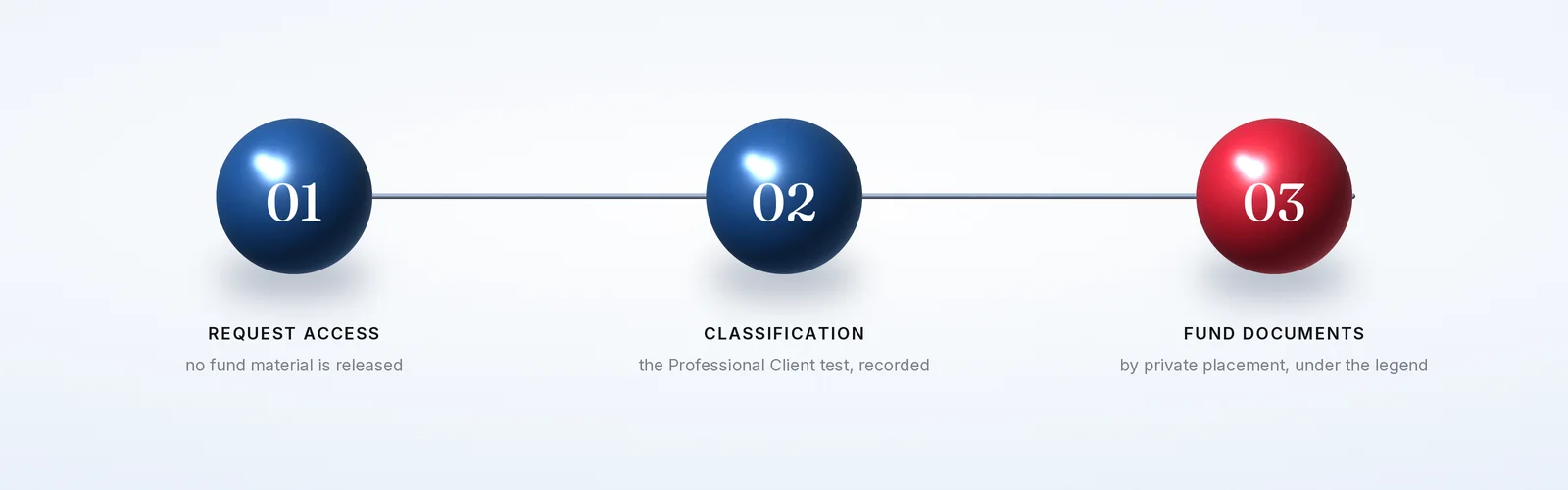
This page is thesis, not offer. No terms are stated here and none should be read into it. The fund is available to Professional Clients only, by way of private placement; those who meet that classification request the fund documents through the access route at universalvc.ae/access, where the required legend and disclosures govern.
Classification comes before content. An enquiry through the access route releases no fund material; it starts the Professional Client assessment the DFSA rules require, and only once that is recorded does documentation follow, under the legend and disclosures that govern it.
Frequently asked

What does sovereign AI mean in this thesis?
The data, the customer relationship and the decision held under the law of the market served, on intelligence the operator can replace. Ownership of the layer where accountability lives.
Does the fund invest in frontier model companies?
No. The laboratories are the fund's infrastructure, not its market. The fund invests in application companies built on their models, and in the in-region serving layer that carries them.
Why not simply buy exposure to the model companies?
There is no venture entry to buy. Frontier rounds are strategic infrastructure financings led by the hyperscalers, priced accordingly and closed to funds of this size and mandate; and the economics of a metered input flow to the layer that owns customers and workflows. The fund holds the layer where early ownership is still possible.
Does AI Frontier mean frontier models?
Frontier means the deployment frontier: the markets and workflows where artificial intelligence is being put to work at scale for the first time. The fund does not fund model training.
Why will the model companies not build these applications themselves?
Their economics are horizontal. Licences, local-language distribution and institutional integration, market by market, are vertical work, and the margin in vertical work belongs to whoever does it.
Where does the fund invest?
Anywhere the five tests hold. The mandate is location agnostic; capital will concentrate where the tests pass most often, which today is the markets of the five billion.
What is Universal Venture Capital?
Universal Venture Capital is the venture brand of Universal Asset Management Limited, which manages UVC AI Frontier Fund I, a closed-ended DIFC venture capital fund. The focus is the application layer of artificial intelligence, invested wherever the fund's five tests hold.
How is Universal Venture Capital related to Universal Asset Management?
Universal Venture Capital is the venture brand of Universal Asset Management Limited, not a separate legal entity. UVC AI Frontier Fund I is managed by Universal Asset Management Limited under its DFSA licence.
Who can invest in the fund?
Participation is limited to persons who meet the DFSA definition of a Professional Client. Professional Clients can request access at universalvc.ae/access, where classification is addressed before any fund material.
What stage does the fund invest at?
The sweet spot is pre-seed and seed, before the company has been priced by a market that has caught up with the argument. The fund brings more than capital: mentorship, technical assistance and the sponsor group's operating playbook arrive with the cheque. It can invest at any stage where the economics of the investment justify it.
Who is the general partner?
AI Frontier Fund 1 GP Limited, a DIFC private company incorporated on 31 July 2026 under registered number 14022. It carries no financial service of its own and delegates management to Universal Asset Management Limited.
Which regulator supervises the manager?
The Dubai Financial Services Authority, under reference F008012, granted 20 December 2023. The licensed activity is Managing a Collective Investment Fund.
What happens to a portfolio company when model prices fall again?
If it passes the fourth test, the saving becomes margin. A company that sells completed work charges against the cost it displaces, not against the price of the model it happens to use.
Does the fund take a view on which model a company should use?
Only that the company must be able to change its mind. Model agnosticism by architecture is the fifth test, and it is the one that turns every price cut into an advantage rather than a discount handed to procurement.
How does the fund treat data residency?
As a moat rather than a burden. An operator that complies in region holds a position the horizontal platform cannot reach, and the statutes creating that obligation are multiplying rather than receding.
How do founders apply?
Founders apply at universalvc.ae/apply. Applications open shortly; in the meantime, founders may write to info@universalvc.ae.